
By Courtney Davison
In the basement of Wheelock Student Center, a familiar flicker of red glows from a small “ON
AIR” sign. Inside, a student queues a track from an indie garage band and leans into the mic.
“You’re listening to 90.1 FM Tacoma,” they say, calm and confident, “K.U.P.S. The Sound.”
According to KUPS General Manager Rhae Shultz O’Neil, KUPS has been the University of
Puget Sound’s student-run radio station for over 50 years, broadcasting 24/7 on FM, and as of
recently, also digitally streaming from their website. Known for its eclectic programming and
anti-mainstream ethos, KUPS isn’t just a platform—it’s a culture. With over 100 DJs per semester
(according to Shultz) and a focus on alternative, underground, and independent music, the station
reflects the diverse and evolving music tastes of the student body.
But in the age of Spotify, TikTok, and algorithmic playlists, does college radio still matter?
Data from the past three years suggests it does.
Between 2022 and 2025, KUPS has seen a remarkable increase in listener engagement.
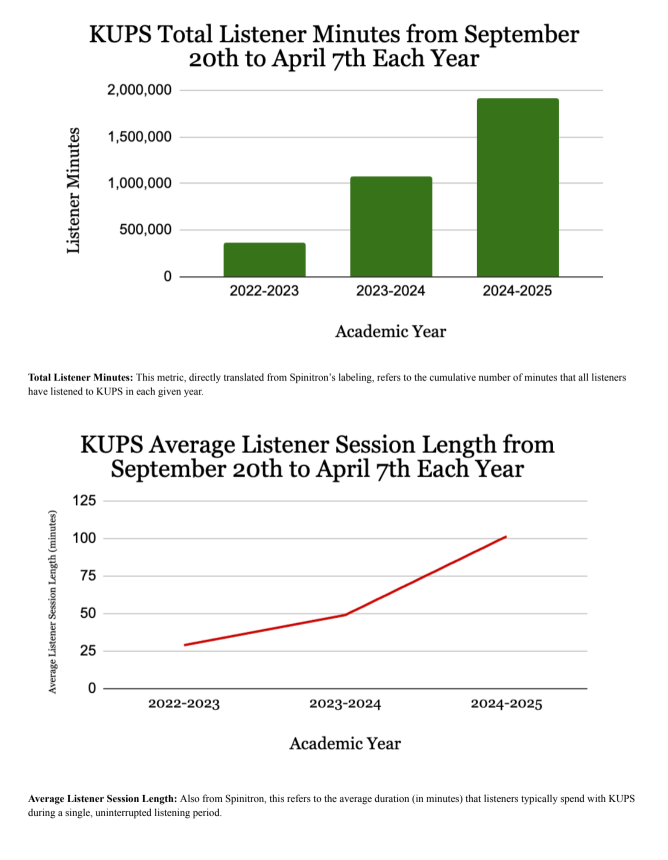
According to data shared by Shultz, total listener minutes jumped from 368,190 in 2022-2023 to
just under 1.9 million in 2024–2025—a 420% increase in just two years. “That’s 1,304 days of
music listening straight,” Shultz says. More telling, though, is the change in how long listeners
stay tuned. “The average listening length is 1 hour and 10 minutes, compared to 29 minutes two
years ago,” Shultz explains.
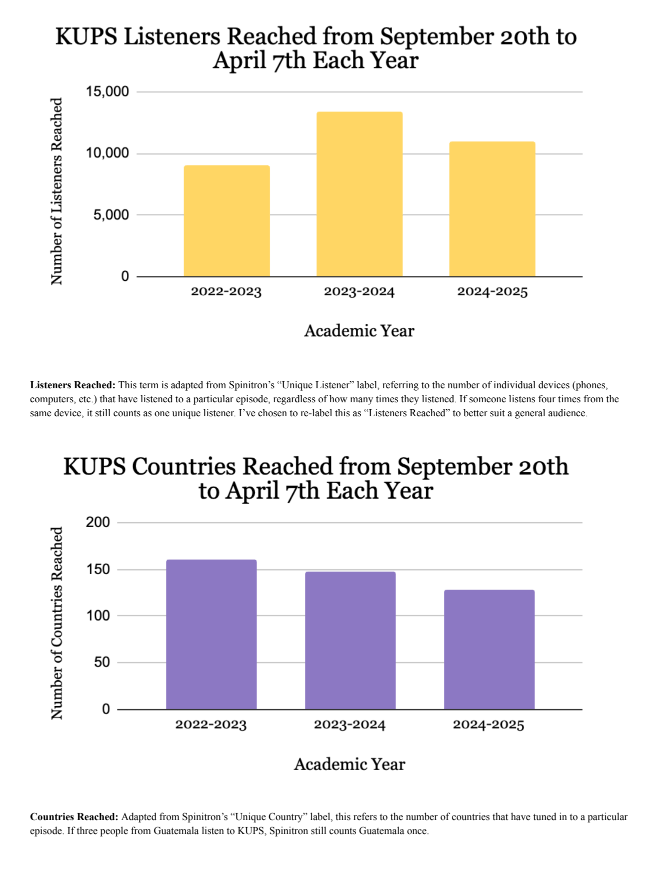
The station’s global footprint remains impressive, though slightly narrowed. While total countries
reached dropped from a high of 160 in 2022-2023 to 128 in 2024-2025, listener hours have
nearly tripled year over year, climbing from 6,136 to 31,915, according to Shultz. Fewer people
may be tuning in, but those who do are sticking around. That tells us that the content is
resonating. Listeners are finding something worth staying for.
KUPS programming is divided into four broad departments: Alternative, Hip Hop, Electronic,
and Specialty. The most popular department is Specialty, which includes anything from
Broadway musical soundtracks to Brazilian funk. “Specialty is the most popular genre because
people are interested in smaller niche kinds of subgenres that we don’t have an umbrella for,”
Shultz explains. For every show, DJs are responsible for logging the songs they play on
Spinitron. According to Shultz, “Every week… our top spun song only has two plays…I think
that gives you a really good glimpse of how diverse the music tastes are that students bring to
the station.”
Shultz also emphasizes how programming evolves based on student interest: “It changes every
semester… We’ve gotten a lot more interest recently in Loud Rock, and even Hip Hop and
Electronic as well…we used to have a Global genre… Jazz, and a Classical genre. Now those
tend to fit more towards Specialty.”
For DJs, being on KUPS means more than playing your favorite artists or songs. Each show is
pitched, designed, and curated by a student with full control over their playlist (within FCC
rules). DJs apply each semester with a theme, a sample playlist, and a time slot preference.
KUPS’s music library is largely made up of physical CDs and MP3 submissions that are sent
directly by artists and small labels. Music directors and interns review every submission and
decide whether it fits station values. Shultz elaborates, “This is really where radio is awesome,
you get to kind of input your personal taste.” CDs are labeled by genre and include written staff
recommendations. “It’s not like a robot playing the music, we’re manually going in and prepping
it,” Shultz explains.
That commitment to underrepresented voices extends beyond programming. KUPS encourages
DJs to highlight artists who are local, independent, or from marginalized communities. Their
in-studio sessions and annual event, KUPS Fest, give artists a platform they might not otherwise
access. According to Shultz, “Meldrop, who has now played for us twice, their first like group
performance or big show was KUPS Fest, and now they’re over 100,000 monthly listeners.”
Compared to many other college stations, KUPS stands out in a few key ways. KUPS has a
remarkably fast DJ turnaround. At most schools, students have to shadow someone for a
semester before getting their own show. At KUPS, students can be on air within weeks of
joining. “We try to get anybody and everybody who’s interested in the booth,” Shultz says.
KUPS is also entirely student-run. From the general manager to the automation logs, everything
is managed by students, no professional staff or university department is involved. “When you
have an organization that involves 100+ students, that right there is a significant percentage of
the student body,” says Shultz. “Not everybody who likes music plays music. So kind of finding
those avenues where we can support just the sharing and communication and love for
music…that’s been a huge importance.”
KUPS’ influence also extends into the wider Puget Sound community. “KUPS has a very
tangible impact on the community…Not only within our organization (just through DJs and
staff) do we have the opportunity to support and engage with arts…but also in terms of event
planning, we can reach such a large percentage of the campus, and that’s such a fun kind of
turnout of KUPS as a whole.”
For many students, KUPS is more than a station—it’s a community. “It’s not just a radio
station…we’re trying to be a hub and center for community engagement,” Shultz says.
KUPS frequently hosts collage nights, screenprinting workshops, CD-burning events, and even
an annual art market. The station is also exploring more live music programming and creative
partnerships with local venues like McMenamins Spanish Ballroom. “It’s about building
community through art. That’s the heart of what we do,” Shultz says.
As KUPS prepares for the next generation of DJs, its leadership is focused on maintaining
momentum and accessibility. Upgrades to streaming tech and increased social media engagement
are already expanding the station’s reach, but the mission remains the same: to provide a
platform for creativity, discovery, and community. KUPS is a place where your taste becomes
your voice. And right now, that voice is being heard louder than ever.
 KUPS "The Sound"
Leave a comment