
By Mozie C.
David Bowie’s legacy as Ziggy Stardust, the development of glam rock, and his footprint on the Moon.
How can a drug-using, omnisexual, human manifestation of an alien being save the people of the world from destroying themselves? According to David Bowie–with the power of love.
Few musicians on the rock circuit of the seventies and eighties reached the experimental ranks of David Bowie. In that period, the British singer-songwriter embodied iconic characters for the artistic culture: he was Major Tom, Halloween Jack, Aladdin Sane, the Thin White Duke, and Jareth, the Goblin King. However, none made quite the cultural impact as his alien persona Ziggy Stardust. Released on June 16, 1972, David Bowie’s concept album “The Rise and Fall of Ziggy Stardust and the Spiders from Mars” debuted during a tumultuous era marked by space exploration and a fervent desire to break free from societal norms.
The album recounts the story of an androgynous rock-star messiah and his posse from space who have come to warn the people of Earth about environmental degradation–before being eventually destroyed by excesses of ego, hedonism, and fan worship themselves.
The impact of Ziggy’s fame not only metaphorically reached the stars; it also reached the far corners of the world as he brought queerness into the public sphere on a scale previously unmatched by chart-topping artists. Although short lived, Ziggy Stardust’s appearance on Earth played a pivotal role in the re-evaluation of human identity of the era. Bowie’s theatrical display of undiluted self expression deconstructed the rigidity that gender identity and sexuality were once attributed with. At the character’s core, Ziggy Stardust can be understood as a deliberate alignment of queer identity with the figure of an alien. This strategic coupling serves as a metaphorical vehicle for Bowie to navigate the uncharted territories of gender and sexual exploration during a time when such conversations were just beginning to find their voice.
Space, Existentialism, and Identity in the Media
The 1960’s were marked by rapid expansion in technological advancements, the arts, and activism; an expansion inspired by the state of deep political, societal, and cultural unrest the world had been living with since the ‘50’s. Advancements in space exploration were made at a rapid rate, and Humankind was in the process of essentially redefining the narrative on which human identity was built upon. At the same time, mainstream media highlighted increasing political anxieties regarding the dangers of existence on Earth. Cold War tensions with the Soviet Union heightened yet again, and as the race to space continued, the imminent threat of technological warfare hung heavy over the public. Marginalized groups were under an immense amount of stress prior, and now in addition, were seated in the splash zone of the time’s increasing tensions. Washing-machine-wives and forcefully-masculinized male figures alike were experiencing the repercussions of binding oneself to their socially casted gender-roles. The white-picket-fenced American Dream was proving to be a mere myth; rather a caging of identity than a source for joy. People were told who they were, who they could be, and what they were capable of. Nearing the tipping point of the 60’s, things were about to change. The people of Earth lifted their gaze to the stars for a sign of hope.
“There’s a Starman waiting in the sky, he’d like to come and meet us, but he thinks he’d blow our minds / there’s a Starman waiting in the sky, he’s told us not to blow it / because he knows it’s all worthwhile” –David Bowie, “Starman”
On July 20th 1969, the world reached a pivotal moment in human history as televisions and radios around the globe tuned in to witness America’s own Neil Armstrong achieve the “impossible.” A human being had finally set foot on the moon. Simultaneously, a pre-recorded copy of David Bowie’s song Space Oddity was used by BBC as background music during its coverage of the event. Bowie had made his mark on the moon too, and with it began his very own exploration of human identity, and space. As the media fixated on exploring the unknowns of the cosmos, themes of existential discovery bled into pop culture.
“But now people want a role in society they want to feel that they have a position they want to be an individual–and I think there’s a lot of searching to find the individual within oneself.” –David Bowie (Finding Fame TV movie 2019)
In Monica Bradley’s book Glam Rock and Funk Alter-Egos, Fantasy, and The Performativity of Identities she speaks on the musical queering of space. She explains, “We can see how certain artists who were marginalized in regards to gender, race and/or sexuality or simply rejected the values of the white heterosexual suburbia might look to space, not as more territory to colonize, but as a place not yet colonized, and a place that can be utilized in the subversion of an oppressive society” (Bradley 387). As humans, much of our identity is based around what we have made of our own experiences. The knowledge that a region beyond a need for conformity existed–and was well within humankind’s reach–was conceptually and monumentally thought provoking. Who are we outside of what we are told we are, on earth? What would it mean to exist outside of that? Who would we be then? In a society where individual identity is confined by a plethora of labels, the knowledge that a place existed yet to be tainted by man’s corruptive social constructs was a celebration for outcasts.
“As humanity reached for the stars, Bowie harnessed the cultural fascination with outer space to craft a profound political statement about gender exploration through the lens of Ziggy Stardust” (Bradley, 388). David Bowie created a character untouched by the judgements of earth. Through his own vision of self expression–Bowie challenged others to imagine a world unbound by societal norms and social labels.
Aliens Wear Glitter Too
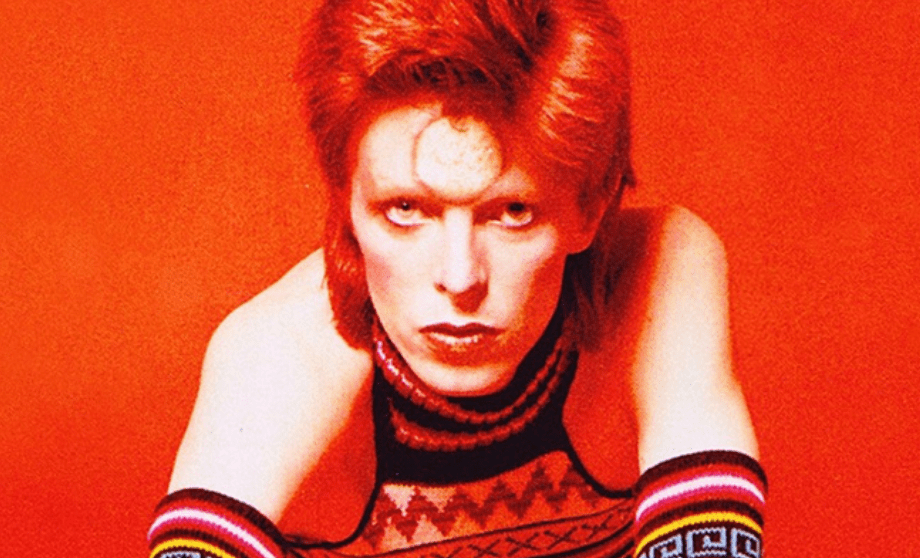
Beyond the comfort of his interstellar love-shack, Bowie brought other rogue aspects of his alien persona to life on stage; one of the most striking elements being the character’s androgynous and gender-bending appearance. The image of Ziggy Stardust is timelessly recognizable, rocking vibrant red hair, a lightning bolt painted across his face, jumpsuits of various degrees of sparkles and sequins more often than not, Stardust has captivated audiences’ attention from inception. With his flamboyant costumes, bold makeup, and extravagant hairstyles, Bowie’s alien defied traditional notions of masculinity and femininity. Kansai Yamamoto designed the Woodland Creatures costume worn by the singer for several performances. Supermodel Kate Moss later wore the same outfit when she accepted a Brit award on Bowie’s behalf in 2014.

David Bowie in his “Woodland Creatures” costume designed by Kansai Yamamoto performing at the Hammersmith Odeon, London in 1973 (left) Photograph: Debi Doss/Getty Images
Kate Moss collecting Bowie’s Brit award circa 2014 (Right) Photograph: Getty Images
Bowie’s artistic blurring of the divide between feminine and masculine expression was, in reality, a statement that the line was never truly real in the first place. He challenged societal expectations, presenting a visual spectacle that encouraged audiences to question and rethink conventional norms surrounding gender identity. David Bowie cemented his legacy in glitter.
In a 1972 interview with Russel Harty, Bowie was questioned on his choice of clothing, “Right and how about the shoes? Are those mens shoes or women’s shoes? Bisexual shoes?” Bowie simply replied “They’re shoe-shoes, silly.”
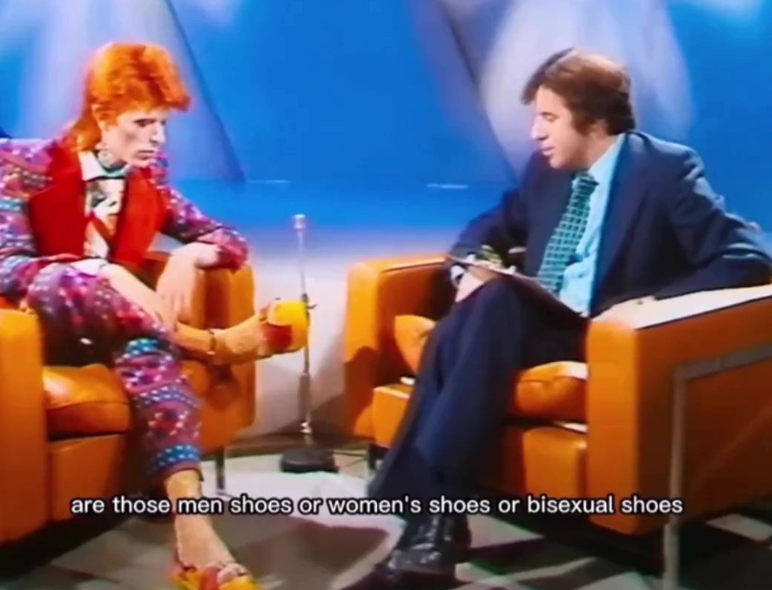
Screengrab from Bowie’s interview with Harty
Ziggy quickly became a symbol of rebellion against heteronormativity. Through performative art, Bowie’s character offered a space for individuals to see themselves reflected in a mainstream musical narrative. And in being an alien, he helped fans accept this alternative vision of homosexuality. Auslander brings together scholarly conversation regarding Bowie’s sexuality, “Bowie’s alien persona was emblematic of his bi-sexual alienation from heterosexual male-dominated world of rock music” (McLeod, Auslander 132).

David Bowie and Mick Ronson (Jack Kay/Daily Express/Getty Images)
Ziggy not only played guitar, but he also kissed his band members, Mick Ronson, Trevor Bolder, and Mick Woodmansey on stage. The ‘70s were considered an exploratory era for many people–and this was clearly reflected through the band’s presence. In a 1972 performance of Suffragette City, Bowie simulated what could have been called “guitar fellatio” Mick Ronson’s 1968 Gibson Les Paul Custom. By normalizing blatantly homoerotic performances as “just another part of the genre,” queerness on stage was made more acceptable and bite-sized for the public to accept.

(Bowie performs “guitar fellatio” on Mick Rock/Dalle)
The Genre
Queer coded performances grew to be what people expected from a glam rockstar at the time. It is vital to note that these queer rockstars wouldn’t have had the safe space to do so if their queer expression was not considered a part of the glam rock performance.
Sheila Whitely, the author of “Popular Music and the Dynamics of Desire” further expands on the phenomenon: “Popular music provides a specific insight into the ways in which fantasy… can signal both what is denied and what we would like to experience. Likewise, fantasy, as is a setting for desire, provides a particular space for the performer themselves, allowing access to otherwise prohibited thoughts and acts via subversion of performance codes associated with particular music genres” (251).
Gaining popularity in the UK throughout the early 1970’s, glam rock was defined as a more “flamboyant” offshoot of the rock genre. Male members of the subculture boldly performed in traditionally feminine clothing, makeup, and hairstyles (particularly platform shoes and glitter); female musicians often sported more masculine clothing.
Categorizing queer performances as “just another part of the glam rock genre” worked as a great cover for queer performers to safely draw attention to themselves and exist within their own identity as well as build a bigger platform in the media.
So, when Bowie said in a 1972 interview with Melody Maker, ‘I’m gay. And always have been,” he transformed and destabilized the masculine rock star identity by bringing attention to the performative aspects of masculine rock performances, which he probably could not have gotten away with had he not been “‘intentionally’ performing an ‘alien’ character himself” (Auslander quoting Watts 134). Through Bowie’s exploration of his own queer identity in his performance of Ziggy Stardust, and then his further open establishment of his queerness, he drew attention to the fact that glam rock was just a code for queer performers. and further established queer identity in the media.
This genre doesn’t exist to the same degree in current times due to the normalization of queer identity in our own culture. The uber-popularity of the glam rock genre in the 70’s was substantial to the normalization of queer expression–not only in the music industry, but in everyday life as well. Paving foundations of the genre was none other than David Bowie. Bowie’s own fluidity in sexual expression further contributed to the queering of Ziggy Stardust. Bowie’s openness about his bisexuality challenged the rigid boundaries of sexuality in the 1970s.
The character of Ziggy, with his androgynous and theatrical presentation, emphasized the performative nature of sexuality. By leaning into his glam rock alter ego Ziggy Stardust, Bowie not only created a safer space to explore his own identity, but for one generations to come.
Beyond the visual statement, Ziggy’s storyline included elements of alienation, otherness, and the tension between self-discovery and societal expectations—themes that have mirrored the challenges that many face whilst existing in the modern era. For an alien, Ziggy Stardust did a beautiful job of capturing the human experience.
The album The Rise and Fall of Ziggy Stardust and the Spiders from Mars features eleven songs about the superstar from the stars: Five Years, Soul Love, Moonage Daydream, Starman, It Aint Easy, Lady Stardust, Star, Hang on to Yourself, Ziggy Stardust, Sufferagette City, and Rock ‘n’ Roll Suicide. Separating himself from his identity as Bowie and aligning with his glam rock performative persona Ziggy Stardust, the British performer was able to safely delve into otherwise taboo subjects of environmental disaster, gender and sexual nonconformity, crossdressing, hedonism, as well as the dangers of ego. Ziggy’s shields of glitter worked as a perfect vehicle to address important societal issues on earth. In aligning his identity with the otherness of space and utilizing the aegis of performance art to dissect his gender identity, David Bowie developed the early glam rock scene, and created space for physical expression of androgyny and gender performance outside of the binary.
One song in particular, Lady Stardust, directly discusses the performativity of gender: “People stared at the makeup on his face / Laughed at his long black hair, his animal grace / The boy in the bright blue jeans / Jumped up on the stage / Lady Stardust sang his songs / Of darkness and disgrace / And he was alright”
In his song Lady Stardust, David Bowie recounts the story of a crossdressing performer and unsheathes the doubled edged sword of unfiltered gender expression–unpacking the freedom that comes along with identifying with one’s self as well as the isolation that results from standing out.
Through his lyricism, Bowie cuts through an experienced heteronormative narrative with such depth that could only be inspired by lived through experience. The song’s mixing of pronouns in a theatrical sense speaks on the performativity of gender–something that is often brought up in queer discourse. In Judith Butler discusses this in her book Gender Trouble: Feminism and the Subversion of Identity:
“If the body is not a being but a variable boundary, a surface whos permeability is politically regulated, a signifying practice within a cultural field of gender hierarchy and compulsory heterosexuality, then what language is left for understanding this corporeal enactment gender, that constitutes its interior signification on its surface? Sartre would perhaps have called this act a style of being. Foucault a “stylistics of existence.”” (1990)
As a character, Ziggy Stardust’s gender expression is not only a form of play for David Bowie but a political statement that challenged the general public to reimagine their own identity and the state of the world. From space to Earth, Bowie was deconstructing himself and the world of rock while simultaneously carving his own place in it.
David Bowie’s persona Ziggy Stardust remains a cultural touchstone for its profound impact on the exploration and expression of queer identity. Through Ziggy, Bowie challenged gender norms, celebrated diversity, and created a space for self-discovery and empowerment. The legacy of Ziggy Stardust endures not only in the annals of music history, but also as a testament to the power of art to shape and transform societal perceptions of identity and difference. Ziggy Stardust’s alignment with an alien identity within the context of space exploration was a deliberate and impactful political statement. Bowie leveraged the cosmic narrative to challenge societal norms and propel discussions about gender exploration into the forefront of cultural discourse. Ziggy Stardust, the extraterrestrial messenger, not only broke musical barriers but also paved the way for a more inclusive and accepting understanding of gender and identity.
Works Cited
Auslander, Philip. Performing Glam Rock; Gender and Theatricality in Popular Music. Ann Arbor: University of Michigan Press, 2006.
Harrick, Stephen. “Performing Glam Rock: Gender and Theatricality in Popular Music.” Theatre History Studies 28 (2008): 165-8.
McMullen, Marion. “ZIGGY POP: DAVID BOWIE INTRODUCED ZIGGY STARDUST TO THE WORLD 50 YEARS AGO. MARION MCMULLEN LOOKS BACK AT THE RELEASE OF THE GROUNDBREAKING ALBUM.” The Plymouth Evening Herald, Jun 14 2022, p. 17.
“Starman.” The Rise and Fall of Ziggy Stardust and The Spiders from Mars. Vinyl Record. RCA Records, 1972.
“Ziggy StarDust” ··? The Rise and Fall of Ziggy Stardust and The Spiders from Mars. Vinyl Record. RCA Records, 1972.
“Lady Stardust.”··? The Rise and Fall of Ziggy Stardust and The Spiders from Mars. Vinyl Record. RCA Records, 1972.
Whitely, Sheila. “Popular Music and the Dynamics of Desire.” Queering the Popular Pitch. Ed. Sheila Whitely and Jennifer Rycenga. New York: Routledge, 2006. 249-62.
 KUPS "The Sound"
Leave a comment