

By Rhae Schulz-O’Neil
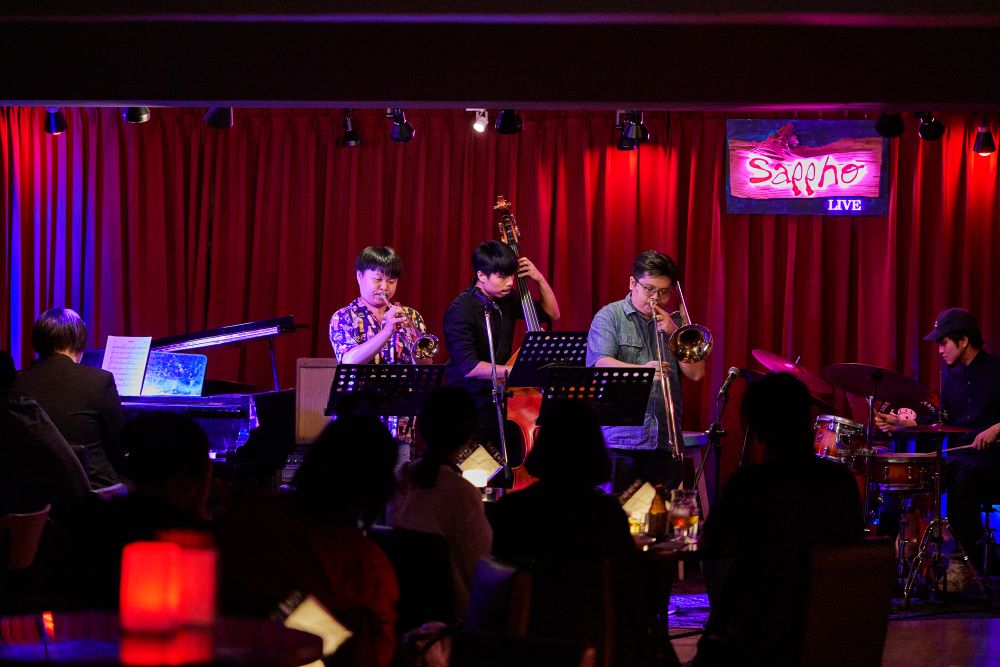
It’s Saturday night in the northern Zhongshan district (中山区) of Taipei (台北) Taiwan and, tucked away in the unsuspecting jazz bar Sappho, people young and old flood in for a taste of live music. The bar, which exclusively houses live Jazz Tuesday through Saturday, at first glance doesn’t seem to have that many visitors, but as I wind down the narrow staircase, it opens into a warm-lit, somewhat classy bar that is anything but empty.
The bar’s doors open at 8, yet music doesn’t start until 9. As I entered at just 8:40, nearly every single seat was taken. “你可不可以站?“ – ”can you stand and watch?” the hostess echoes my way. The owner (or the woman I assume to be the owner) then whips around, chats up two or three couples, there are some nods and they slide closer together creating a small opening. And, soon enough, I find myself sitting on a stool packed into a corner to the couples’ right. Even after I’m seated I’d say 15 or so more people made their way down. And, just as before, the owner finds them each a seat. There are strangers packed around tables, people sitting on stools in the aisle, and at least 6 people just standing. It is a beautiful sight–so many random people squishing into this small space without a single complaint. There are people seated behind poles with no way of seeing the band, but no one really seems to mind. Jazz can often be seen as an intimidating or somewhat pretentious music genre for some simply because of the spaces it is often showcased. This–even despite the classy atmosphere and well dressed crowd– felt cozy and friendly, the packed room full of chatter and laughs.
The band playing this evening was “Nomad Factory,” a four piece band (quartet) composed of a pianist (and accordion player I soon discovered), saxophonist (and flutist), contrebassiste, and drummer. After some later research, I found their names are: Lionel Pinard (李歐), 謝明諺 (Minyen Hsieh), 王群婷 (Refa Wang), and 林偉中 (Weichung Lin). I place Lionel’s Chinese name in parentheses as opposed to the others because, from what I can find, Lionel–who is also the composer–is French, while the remaining members are Taiwanese.
Nomad factory, as the name might suggest, opens with a piece that had very clear African influences. This can best be described as a lack of a steady tempo and melodic and almost improvisational piano riffs, similar to the sounds of Ethiopian Jazz such as Emahoy Tsege Mariam Gebru and Alemayehu Eshete–especially with the flute riffs. Their name, Nomad Factory, seems to be a very conscious choice, and is very reflective of their style as a whole. Nomad–someone who travels from place to place, usually in reference to finding fresh pasture for animals–is instead a reference to them as musicians traveling from place to place to find inspiration and new sounds. So, it may come to no real surprise that they also played a couple balkan folk/dance covers, as well as an original titled “I forgot my pants” which had some serious Balkan influence. They felt very reminiscent of Balkan Artists Goran Bregovic and Fanfare Ciocarlia with their upbeat and danceable beats (this is also where the accordion made its appearance and rightfully so).
“I forgot my pants’ ‘ was easily my favorite of the night, as I thought it was a brilliant balance of silly, danceable, but also well composed. The packed crowd was invested in the entire set; a glimpse around the room and legs were tapping, heads were nodding, and smiles were smiling. The atmosphere was lively with claps and chatter after solos, but mouths were shut when the music was playing. The musicians were feeling the crowd and some people danced despite the very limited space left. It was clear to see this was a space for music lovers.
Although Nomad Factory does not seem to be on streaming platforms, they have a couple recorded shows on their youtube that are seriously worth checking out.
Taiwan, while maybe not on most people’s radar as a music hub, has a vibrant and growing music scene, and Sappho is the perfect example. If you ever find yourself in Taiwan I highly suggest stopping by.
 KUPS "The Sound"
Leave a comment